TL;DR
67% of B2B buyers research digitally before talking to sales. Logistics companies in LATAM without real digital infrastructure do not appear in that stage — and never get to compete. This article explains why, what digital infrastructure means in business terms, and where to start.
In logistics, we have spent decades building businesses on something that works: relationships, referrals, reputation. And it still works. I am not going to contradict that.
But after 20 years moving international cargo, with operations across several LATAM markets, I started noticing a pattern that repeats too often to ignore.
Serious companies, with real operations, experienced teams, and years of track record, losing opportunities before the prospect even calls them. Not for lack of capability. For lack of a digital presence that reflects what they truly are.
That is no longer a minor problem. It is a commercial problem.
The referral model has a ceiling
The referral channel is efficient. But it has a structural limit: it only reaches the people inside your network. Everything that exists outside that circle — companies that do need your service but do not know you — simply never arrives.
And while that happens, B2B buyer behavior changed. Gartner reported in 2025 that 61% of B2B buyers prefer to research independently before talking to sales. In 2026 that number rose to 67%.
In logistics that translates into something very concrete: when an importer, exporter, or supply chain manager needs a freight forwarder, a 3PL, or a last-mile provider, the first move is a digital search. Google, LinkedIn, AI tools. All of that before the first contact.
6sense confirmed something even more relevant: in many cases, the winning vendor was already on the buyer's shortlist from the start of the process, before sales even knew that lead existed.
If you are not in that stage, you do not lose a sale. You never got to compete.
How a buyer researches before reaching out to you
McKinsey documented in its B2B Pulse 2024 that most decision-makers use ten or more channels throughout the buying process. In logistics, that has a very concrete translation.
First they search on Google. They visit the website. They check whether the services are clearly explained or whether it is a generic page of "comprehensive logistics solutions." They look up the company on LinkedIn to see if there is real activity. They check Google Business for photos, reviews, and contact details. And increasingly, they use AI tools to compare options before making a decision.
All of that happens before the first call. And it happens even when the client came through a referral — because even when someone recommends a company, they still research it before making contact.
What I have seen repeatedly with logistics operators in LATAM is this: the site exists, but it does not survive that inspection. Not because it looks bad. But because it does not answer the right questions. What routes do you actually handle? Do you have experience with refrigerated cargo? Do you operate at that port? If those answers are not clear on the site, the buyer does not ask — they move forward with whoever has them clearly stated.
The problem is not the website — it is what lies beneath
Here is the most common mistake I see in logistics companies in LATAM: confusing having a website with having digital infrastructure.
A website can look professional, have good colors, photos of containers, and a contact form, and at the same time be completely useless as a commercial asset.
Why? Because what a manager sees on screen is only one layer. Beneath it exists another reality: the code structure, the clarity of services, the indexability of content, the technical signals that allow Google and AI systems to understand what the company does, for whom, and in which areas it operates.
I have reviewed sites of logistics operators in LATAM where the main services — FCL, LCL, special cargo, customs — are buried in a single generic page with no differentiated structure. Google cannot interpret what that company offers exactly. And if Google cannot interpret it, it cannot show it to whoever is searching for it.
Google documents this directly: its AI features, including AI Overviews and AI Mode, continue to rely on technically crawlable and indexable web content. A page can look impeccable to a human and still be invisible or irrelevant to a search engine or LLM.
That is the real problem. Not the design. The structure.
What digital infrastructure means in business terms
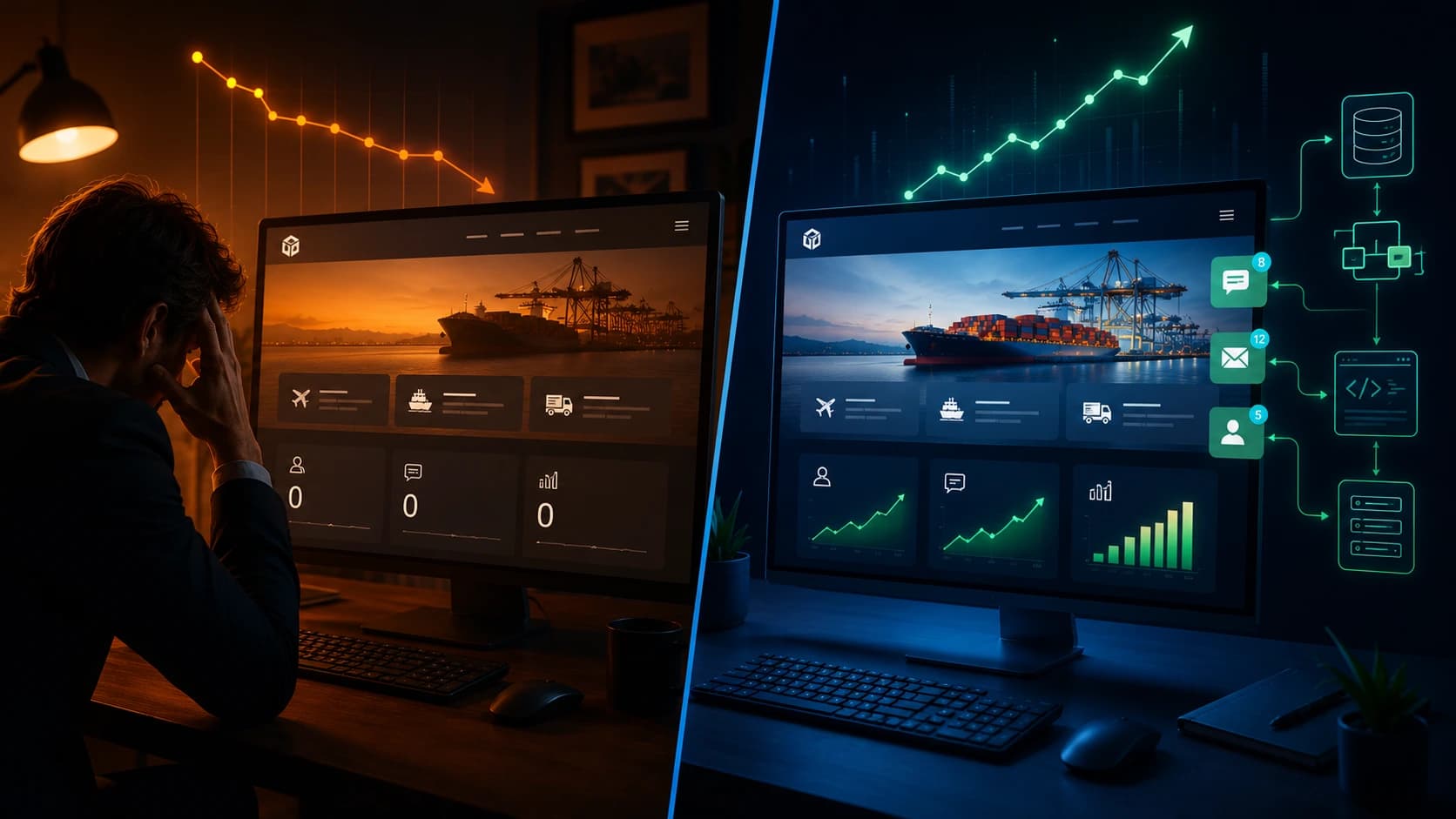
When I talk about digital infrastructure I am not talking about "doing marketing" or "being on social media." I am talking about a connected commercial system that works for the company every day, with or without the salesperson being active.
That system has four concrete components that reinforce each other.
Website with real structure
Specific pages per service: FCL, LCL, refrigerated cargo, customs, last mile. Technical structure that Google can read and index correctly.
Active Google Business Profile
With real photos of operations, detailed services, and responded reviews. In LATAM this point is almost universally neglected — a real advantage for whoever works it.
Aligned LinkedIn
The company page with activity consistent with what the website says. In B2B, coherent omnichannel experience has become part of growth.
Basic measurement working
GA4, form tracking, conversion events. Without this, the company operates on intuition and cannot improve what it does not measure.
How this connects to concrete revenue
The sequence is direct: visibility → understanding → trust → contact → commercial opportunity.
First they find you. Then they understand what you do. Then they decide whether you transmit enough trust to reach out. And only at that point does the real opportunity to sell appear.
In logistics that sequence carries more weight than in other industries, because the buyer is choosing someone who will handle their cargo, their timelines, their operation. Trust is not a detail. It is the central criterion of the decision.
There is also an element that few companies are leveraging: when measurement is correctly configured, digital infrastructure becomes commercial intelligence. You can detect whether a prospect you met at a trade show visited your site afterward, which pages they reviewed, and how much time they spent on each. Instead of a generic follow-up, you can reach out with relevant context.
Your competitors leave the same trade show, hand out the same card, and wait. With correct measurement, you can operate with more information. That does not replace relationships. It amplifies them.
AI is already evaluating logistics companies — do you appear?
This is already happening.
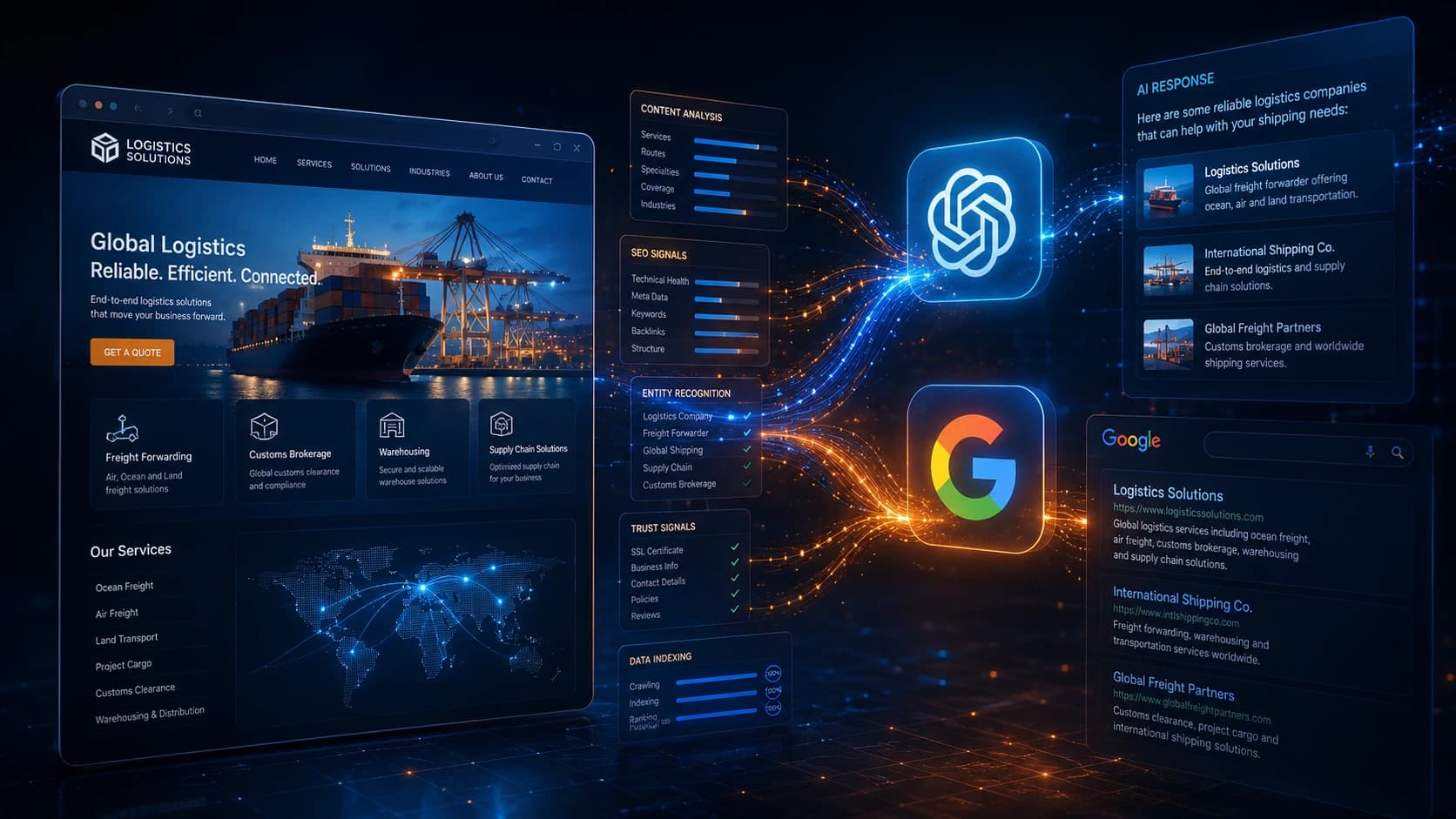
When a buyer uses ChatGPT or Google AI Overviews to search for a freight forwarder or a 3PL in their region, the system generates a response based on the content available on the web. The best structured, clearest, and most consistent company — across its site, business profile, and professional presence — has an advantage in that response.
Not necessarily the largest. Often the best explained.
I ran this test: I searched ChatGPT for freight forwarders in several LATAM markets. The results are revealing. The companies that appear are not necessarily the largest or the most experienced. They are the ones with clear, structured, and consistent content on the web. Operators with decades of track record, moving significant volumes, simply do not appear — because their digital infrastructure does not allow these systems to interpret them correctly.
That is the real opportunity for whoever acts now.
The real cost of doing nothing
It is not just "having an old website." That is the most visible symptom.
The real cost is different: leads that never arrive because you do not appear in the right search, prospects who did evaluate you but did not find enough clarity to move forward, competitors with less experience but better explained who capture attention first, and operation without real feedback because there is no measurement.
All of that without receiving a single notification. The prospect moves forward with another option and you never know they existed.
Where to start
You do not need to redo everything. You need to organize the essentials with the right criteria.
Define precisely what services the company offers — not generically, but in terms a client understands: specific routes, modalities, geographic coverage, cargo types.
Audit whether that information is clear on the site — not only visually, but also in its technical structure. Can Google understand what you do and for whom?
Align the website, Google Business Profile, and LinkedIn so they all tell the same story with the same level of detail.
Install basic measurement. Without data, improvement is impossible and there is no way to know what is working.
Treat this as a continuous practice. Digital infrastructure is not a one-time project — it is an asset that is built and maintained.
In logistics, the way commercial opportunities are generated is changing. Referrals still work. But the client who arrives by referral still researches digitally before calling. And the buyer who is not in your network — who does need what you offer but does not know you — only finds you if your digital infrastructure works correctly.
The question is not whether you should build that infrastructure. It is when.

Juan Carlos Morales
Founder, Eurekarank
Freight forwarder with over 20 years of experience in international logistics in LATAM. Founder of Eurekarank, specialists in digital infrastructure for B2B logistics and industrial companies.
Frequently asked questions
What is digital infrastructure for logistics companies?
It is the set of technically structured digital assets that allow a logistics company to be found on Google and AI tools, build trust before the first contact, and convert visits into real commercial inquiries. It includes a website with the correct technical structure, Google Business Profile, LinkedIn, and result measurement.
Why does a freight forwarder need digital infrastructure?
Because 67% of B2B buyers research independently before talking to sales. If a logistics company does not have a clear and technically correct digital presence, it does not appear in that research stage — and never gets to compete for that business.
What is the difference between having a website and having digital infrastructure?
A website is a visual layer. Digital infrastructure is what lies beneath: technical structure, content indexable by specific services, signals that Google and LLMs can read and interpret. A site can look good and still be completely invisible to search engines and AI.
How long does it take to see results?
It depends on the starting point. Technical improvements take effect within weeks. Organic positioning takes between 3 and 6 months for competitive queries. The return builds cumulatively — each improvement adds to the previous one.
Does Eurekarank work with logistics companies outside Panama?
Yes. We work with freight forwarders, 3PLs, customs agents, and B2B industrial companies throughout LATAM. Operational knowledge of the sector is a central part of our methodology.
Ready to act?
Turn your website into a real commercial asset
Free initial audit for B2B logistics and industrial companies in LATAM.
Request Free Audit