TL;DR
Most logistics company websites in LATAM don't generate clients because they were built to exist, not to work. It's not a design problem — it's a structure problem. This article explains exactly what fails, what a logistics site that generates results needs, and where to start.
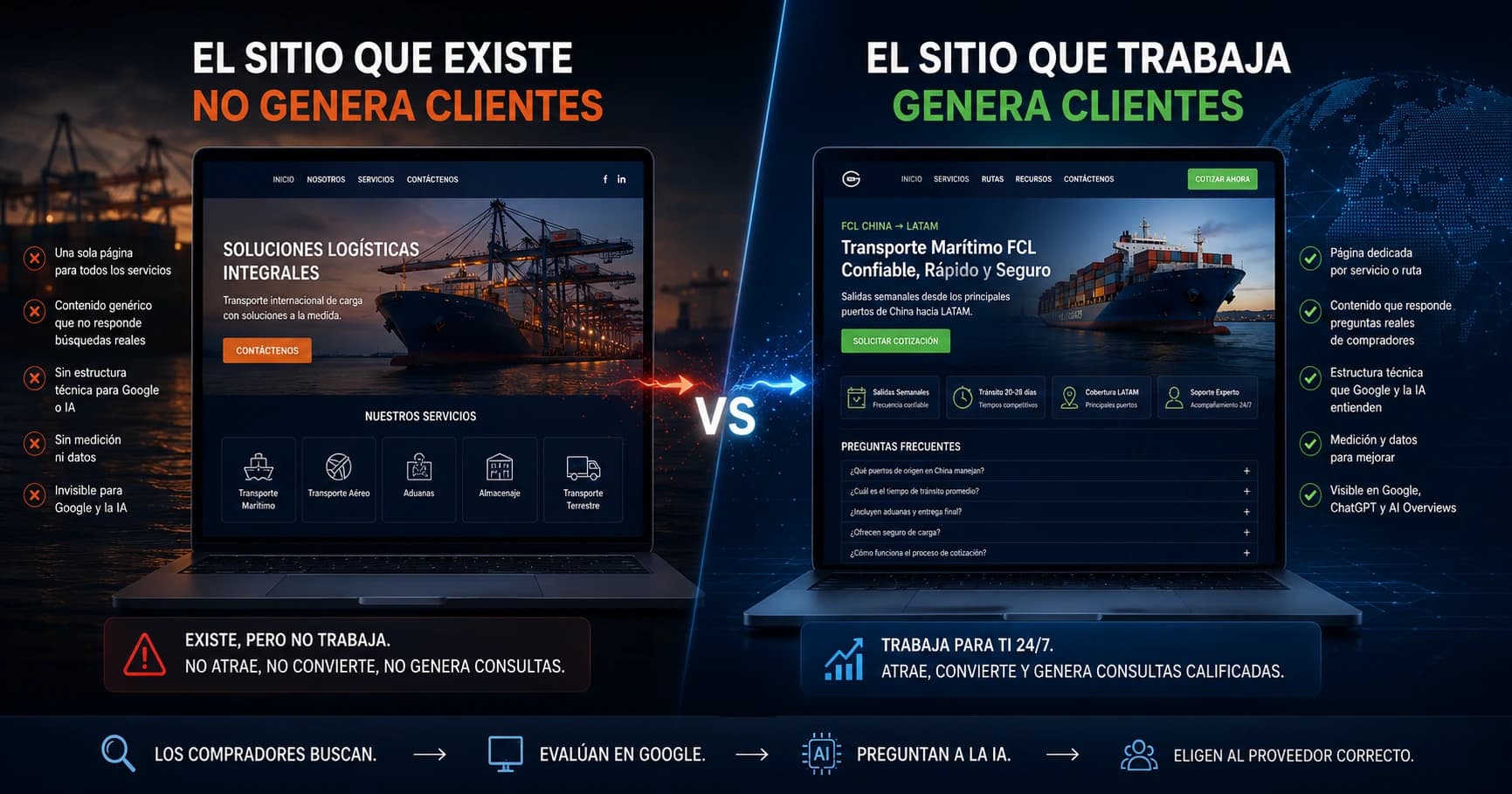
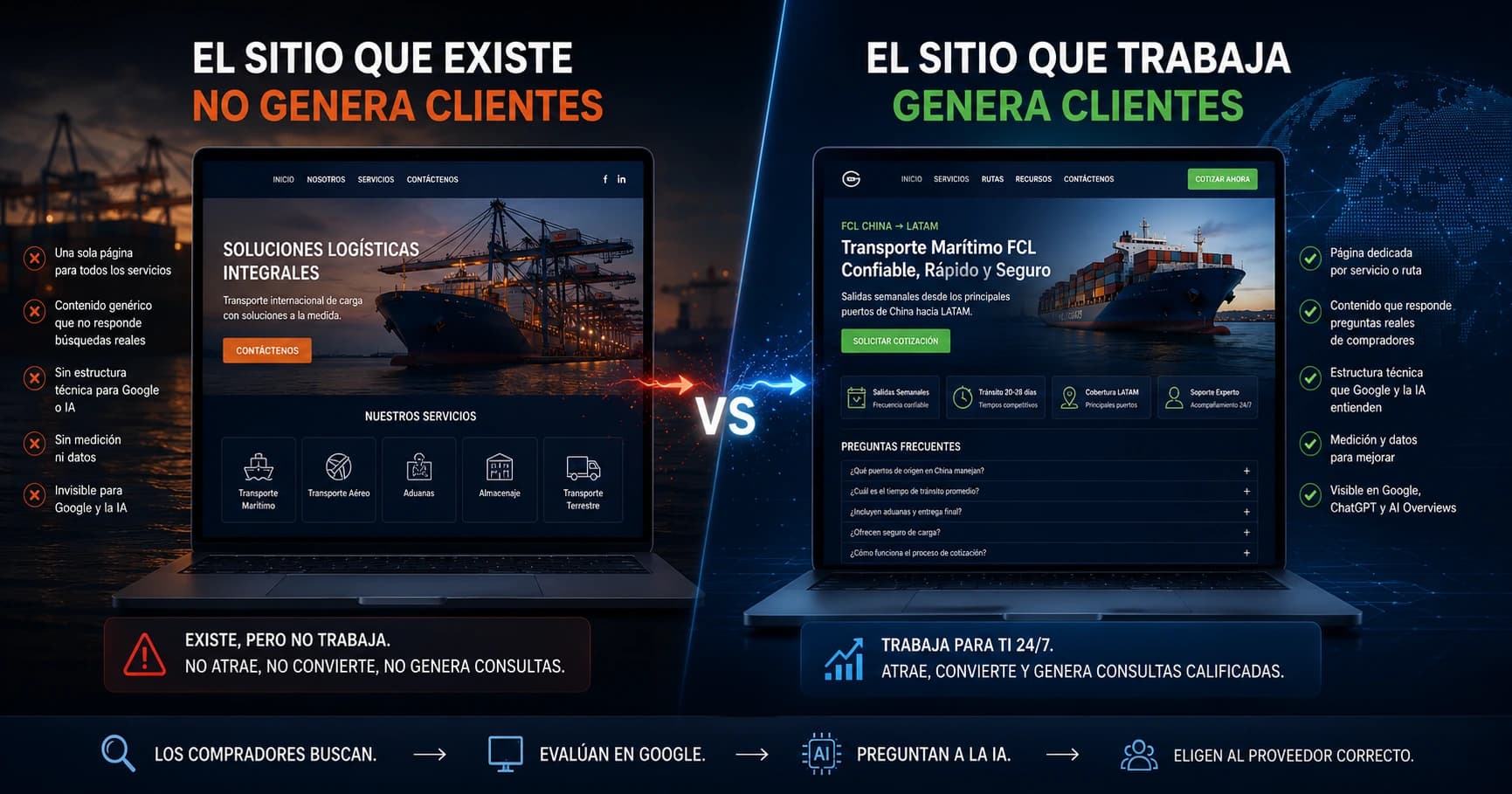
Most logistics websites in LATAM are not broken. The problem is worse: they exist — but they don't work.
When a logistics company tells me their site generates nothing, the first thing I do is review it. And in almost every case I find the same thing: the site is live, has pages, has photos, has a contact form. But it doesn't work.
There is an enormous difference between the two things, and most logistics operators in LATAM don't see it because no one has explained it to them in concrete terms.
That is exactly what I am going to do in this article.
The site that exists vs the site that works
A site that exists fulfills having a digital presence. Someone who already knows you can find it, see your contact details, and write to you. That is all it does.
A site that works does something different: it attracts people who don't know you yet, convinces them you are the right option, and converts them into real commercial inquiries — without you doing anything actively.
Most logistics sites in LATAM are the first type. They were built thinking about the current client, not the future client. And that has direct consequences on how much new business arrives.
A site that only exists is a passive asset. A site that works is an active salesperson 24 hours a day.
Why design is not the problem
When a logistics company decides to improve its digital presence, the first thing it thinks about is design. More modern, better photos, corporate colors, animations. And there are agencies willing to charge well for that.
The problem is that design is not what determines whether a site generates clients or not. I have reviewed logistics sites in LATAM that look impeccable — clean, professional, well-executed design — and generate not a single inquiry. And I have seen visually simple sites that do work.
The difference is not in what the human eye sees. It is in what Google reads.
A site can look good to a person and at the same time be completely invisible to a search engine. Because Google does not evaluate whether the photos are beautiful or the colors are corporate. Google evaluates whether the content answers the questions your clients ask, whether the structure is logical, and whether the technical signals are correct.
Redesigning without rethinking the structure is like painting a building with broken foundations.
What really fails in logistics websites
After reviewing dozens of logistics operator sites in Panama, Colombia, Guatemala, and other LATAM markets, the problems repeat in the same areas every time.
All services on a single page
FCL, LCL, air freight, customs, warehousing — all on one generic page. Google cannot interpret exactly what you offer. If it cannot interpret it, it cannot show it to whoever is searching for it.
Content that doesn't answer real searches
"Comprehensive logistics solutions" is what nobody searches for. What your clients search for is "freight forwarder LATAM" or "customs agent import". If your content doesn't answer those queries, you don't appear.
No interpretable technical structure
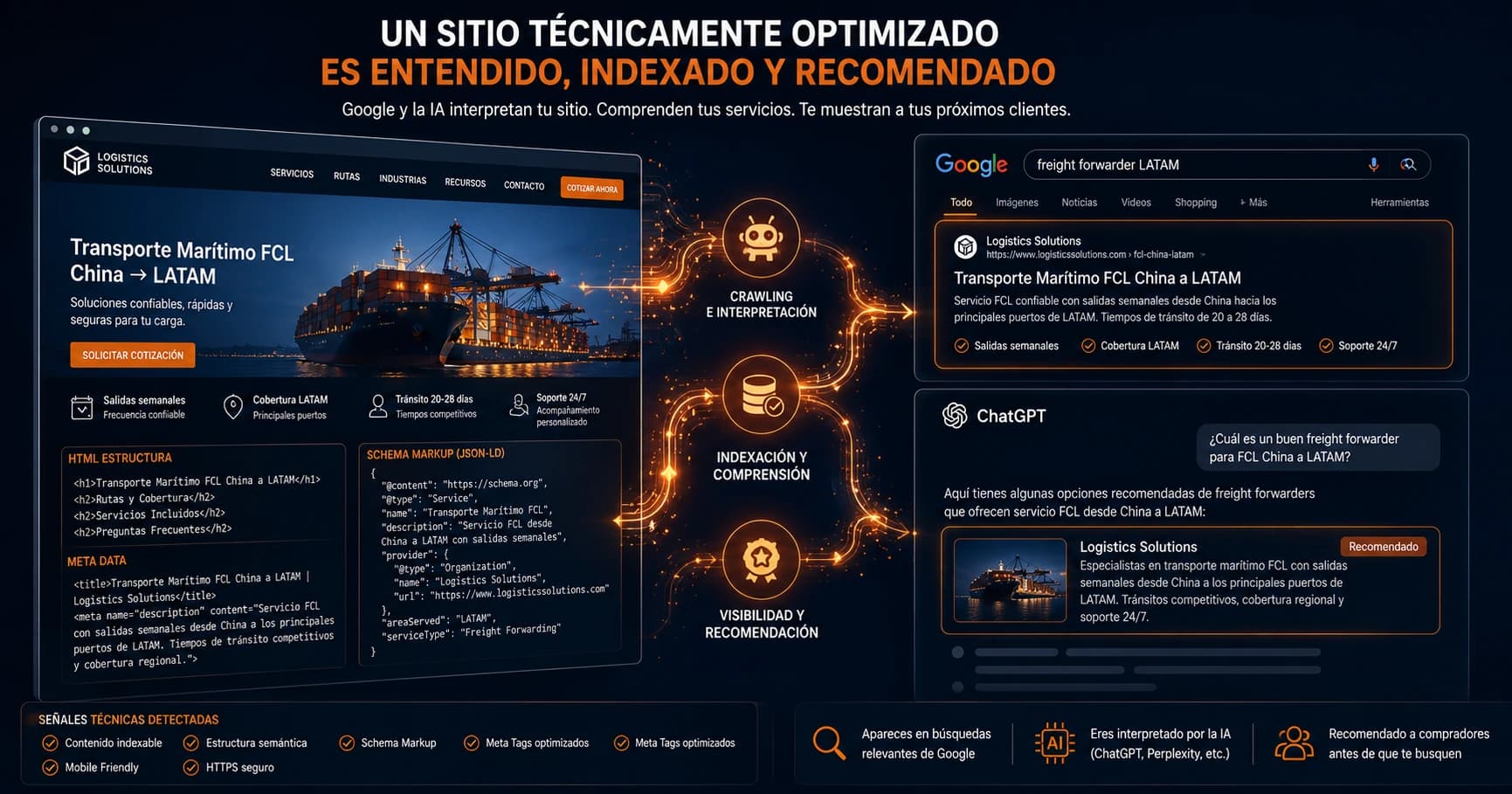
If your site doesn't have technical structure that AI systems can read, Google and ChatGPT don't understand what your company does — and therefore cannot recommend it correctly. Schema markup, semantic HTML, and indexable content are not optional.
No measurement
No GA4, no form tracking, no conversion events. The company doesn't know if someone visited the site, what they reviewed, or if a prospect visited the page after a trade show. It operates completely blind.
None of these problems are solved with a visual redesign. They are solved with a structural rebuild.
What a logistics site that generates clients needs
It is not complicated in concept. But it requires doing it right from the start, because fixing it afterward costs more than building it correctly from the beginning.
One page per service
If you offer FCL, LCL, air freight, customs, and warehousing — each one needs its own page. Not as a submenu, but as an independent page with its own content. Google needs to understand exactly what you offer to show it to whoever searches for it.
Content that answers your clients' real questions
Not generic agency text. Concrete answers to what they search for: what routes do you handle? how long does clearance take? do you have experience with refrigerated cargo? do you operate at that port? If those answers are not on the site, the buyer moves forward with whoever has them.
Technical structure that Google and AI can read
Schema markup, semantic HTML, content visible without JavaScript. This is what allows search engines and AI systems to understand what your company does, for whom, and in which areas it operates.
Speed on any device
The supply chain manager evaluating providers does it from their phone, often before the first call. A slow-loading site loses clients before they read a single word.
Measurement from day one
GA4, form tracking, conversion events. Without this you cannot improve what you don't measure, and you cannot know what is generating results and what is not.
The role of Google and AI in B2B logistics decisions
Something changed in the last two years that most logistics companies in LATAM still don't have on their radar.
The provider evaluation process no longer starts with a call or a referral. It starts with a search. Google first. Then LinkedIn. Then — and this is new — AI tools like ChatGPT or Google AI Overviews.
When an importer, a supply chain manager, or a manufacturing company owner needs a freight forwarder or a 3PL, they increasingly use these tools to compare options before the first contact. And the responses AI generates are based on the content available on the web.
I have run this test across several LATAM markets. The results are consistent: the companies that appear in those responses are not necessarily the largest or the oldest. They are the ones with clear, structured, and technically correct content. Operators with decades of experience and real operations simply don't appear — because their digital infrastructure doesn't allow these systems to interpret them correctly.
In 2026, if your logistics company is not structured to be understood by Google and AI, it doesn't exist for a growing portion of your potential clients.
Where to start
You don't need to tear everything down and start from scratch. You need to understand what is failing first — with precision, not assumptions.
Audit your current site with technical criteria: does it have a page per service? does the content answer real searches? can Google read it correctly?
Check whether you have measurement installed. Without GA4 and conversion tracking you cannot make informed decisions about anything.
Identify which services generate the most business for you and make sure each one has its own page with specific content.
Verify how you appear when someone searches for your services on Google — without your company name, the way a new client would.
Evaluate whether your company appears when you ask about your services in ChatGPT or Google AI Overviews. If it doesn't appear, that tells you something concrete about your technical infrastructure.
For years, many logistics companies were able to grow without real digital infrastructure because the market depended almost entirely on relationships and referrals.
That is starting to change.
The companies that structure their digital services better will have an enormous visibility advantage in the coming years. Not because they are the largest or the most experienced — but because they will be the easiest to find, understand, and evaluate.
The question is not whether your logistics company needs digital infrastructure. It is when you are going to build it.

Juan Carlos Morales
Founder, Eurekarank
Freight forwarder with over 20 years of experience in international logistics in LATAM. Founder of Eurekarank, specialists in digital infrastructure for B2B logistics and industrial companies.
Frequently asked questions
Why doesn't my logistics website appear on Google?
The most common causes are: no separate page per service, content that doesn't answer your clients' real searches, missing schema markup, and content that depends on JavaScript to render. An SEO/GEO audit identifies exactly which applies in your case.
What should a freight forwarder website have to generate leads?
A freight forwarder website that generates leads needs four things: a page per service (FCL, LCL, customs, air freight) so Google knows what you offer, content that answers what your clients search for, fast loading on any device, and measurement installed from day one. Most logistics sites in LATAM are missing all four.
What is the difference between a website and digital infrastructure?
A website is the visual layer. Digital infrastructure is what lies beneath: the technical architecture, content indexable by service, the signals that Google and LLMs can read and interpret. A site can look professional and at the same time be completely invisible to search engines and AI.
How long does it take for a logistics site to generate results?
Initial indexation occurs in the first 2 to 4 weeks. Consolidated organic positioning takes between 3 and 6 months depending on competition. The return builds cumulatively — each improvement adds to the previous one.
Does Eurekarank work with logistics companies outside Panama?
Yes. We work with freight forwarders, 3PLs, customs agents, and B2B industrial companies throughout LATAM. Operational knowledge of the sector is a central part of our methodology.
Want to know what's failing on your site?
Free audit for your logistics company
We review your site against the same criteria in this article and tell you exactly what is failing.
Request Free Audit