TL;DR
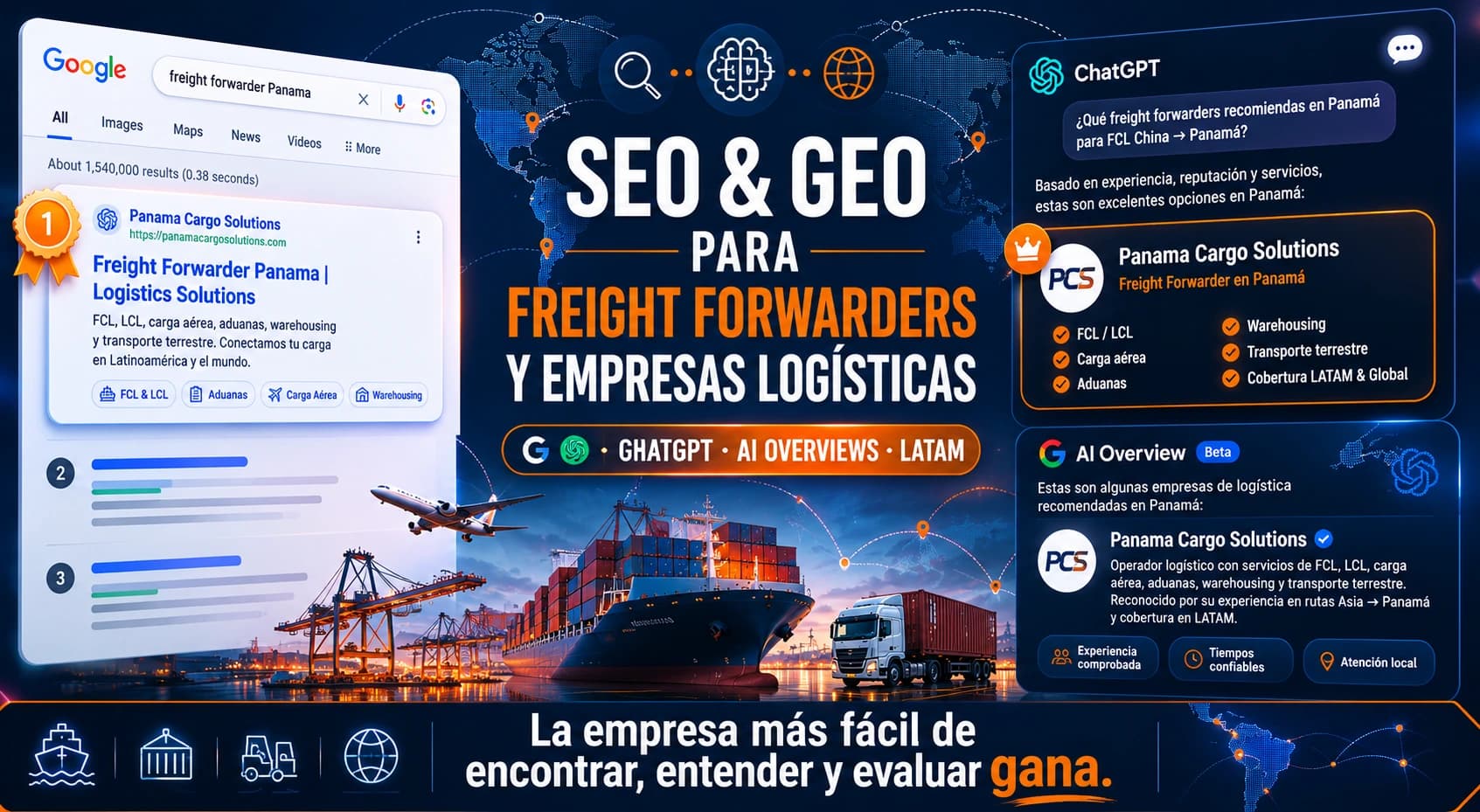
The way clients find freight forwarders and logistics companies is changing. Google AI Overviews, AI Mode and ChatGPT already participate in the provider evaluation process. SEO remains the foundation — GEO and AEO expand how that information is interpreted by AI. This article explains what they mean in logistics, why most companies don't appear, and what to do starting today.
For years, the logistics industry in LATAM grew primarily through relationships, networking, referrals, and trade shows. And all of that still works.
But something important changed.
Today, a B2B buyer rarely makes a decision without researching digitally first. Before contacting a freight forwarder or a 3PL operator, many people now search Google, check LinkedIn, ask ChatGPT, and read Google AI Overviews.
The commercial conversation no longer necessarily starts with a phone call. It starts with a search. And increasingly, that search happens inside AI-powered experiences.
The silent change in how buyers search for logistics providers
Before contacting a freight forwarder or a 3PL operator, a B2B buyer in 2026 typically:
Searches Google
Specific queries like 'freight forwarder Panama' or 'FCL China LATAM'
Asks ChatGPT
Directly asks which companies handle a specific service in their region
Reads Google AI Overviews
Receives synthesized answers without necessarily clicking on results
Checks LinkedIn
Validates credibility, experience, and activity of the company
AI already participates in the commercial process — even though many logistics companies in LATAM haven't noticed yet.
What is SEO in logistics
SEO stands for Search Engine Optimization. For logistics companies, the practical explanation is simple:
SEO is structuring your company to appear when someone searches for exactly the service you handle.
Real examples of what your clients search for:
"freight forwarder Panama"
"FCL China Panama"
"3PL ecommerce LATAM"
"customs agent import Panama"
"refrigerated cargo Central America"
"consolidation Miami LATAM"
The problem is that many logistics companies still have sites that are too generic. Phrases like "comprehensive logistics solutions" or "international services" provide very little context. Google needs to understand exactly what you do, what services you handle, what routes you dominate, and in which markets you operate. If it can't interpret that clearly, it can't show you when someone searches for it.
What is GEO — and what is AEO
GEO stands for Generative Engine Optimization. Also known as AEO (Answer Engine Optimization). Two terms for the same concept: optimizing so that generative AI tools can understand and recommend your company.
These tools include Google AI Overviews, Google AI Mode, ChatGPT, Gemini, and Perplexity.
While traditional SEO aims to help you appear in search results, GEO/AEO aims to ensure AI tools can understand your company, interpret your specialization, and recommend you correctly when a buyer asks.
AI already participates in the logistics provider evaluation process — even though many companies in LATAM haven't noticed yet.
Google AI Mode and the new search environment
Google recently made clear that Search is entering its biggest transformation in over 25 years. The traditional experience based on "10 blue links" is changing.
Now Google AI Mode and AI Overviews work much more like a conversation: they interpret long questions, synthesize information, compare options, and generate structured answers. And something important: many times the user no longer clicks. AI answers directly.
That completely changes the game for logistics companies. Because before it was enough to try to rank. Now you also need to be understood, be cited, and appear inside the generated response.
Visibility no longer depends solely on ranking. It depends on how Google and AI tools interpret your company.
SEO and GEO don't compete — they complement each other
One of the most common mistakes is thinking that GEO replaces SEO. It doesn't. Google has made clear that AI Overviews and AI Mode still depend on the traditional Search Index.
The foundation remains the same: indexation, technical architecture, correct structure, clear content, authority, speed, and useful pages. What changes is the environment where that information is consumed.
SEO — the foundation
Indexation, technical architecture, clear content, speed, pages per service. Without this, nothing else works.
GEO/AEO — the extension
Structure for AI, citable FAQs, authority, schema markup. Expands how that information is interpreted by AI systems.
Why most logistics companies don't appear
After reviewing multiple freight forwarder, 3PL operator, and logistics company sites across LATAM, the same problems repeat constantly.
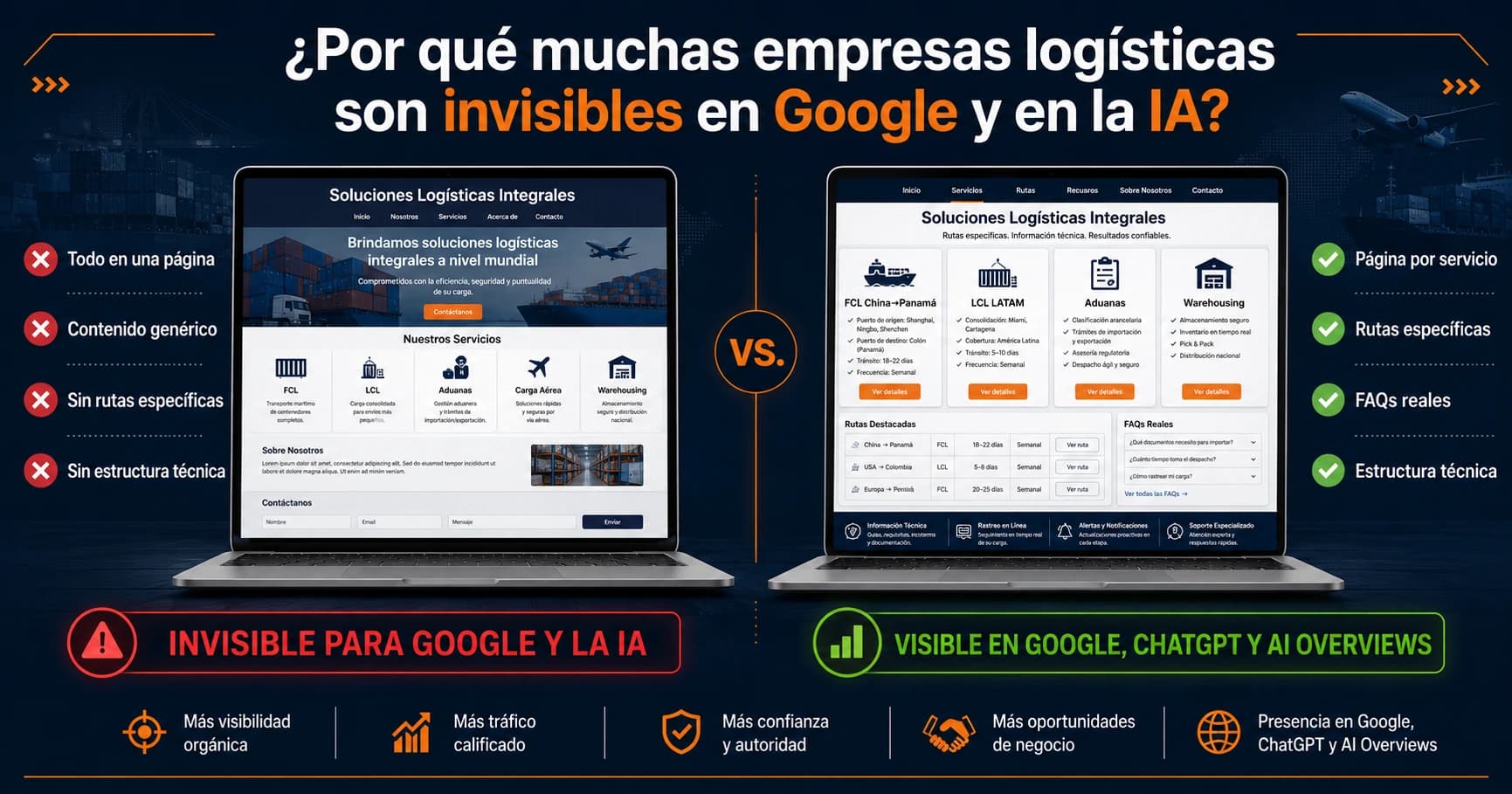
Everything on a single page
FCL, LCL, warehousing, customs, air freight, and ground transport all mixed on one generic page. Google AI Overviews and ChatGPT can't clearly understand which service the company dominates.
Routes and specialization not explained
Many companies do have real experience — but they never make clear what routes they handle, what markets they know, what type of cargo they dominate. If that's not explicit, AI can't infer it.
Content too generic
"Comprehensive logistics solutions" doesn't answer real questions. What buyers search for is specific: "FCL China Panama", "3PL ecommerce LATAM", "Miami consolidation".
No interpretable technical structure
Excess JavaScript, non-indexable content, missing schema markup, no FAQs. If Google or ChatGPT can't interpret the content correctly, they simply don't show it.
What a logistics company needs to appear in Google AI Overviews and ChatGPT
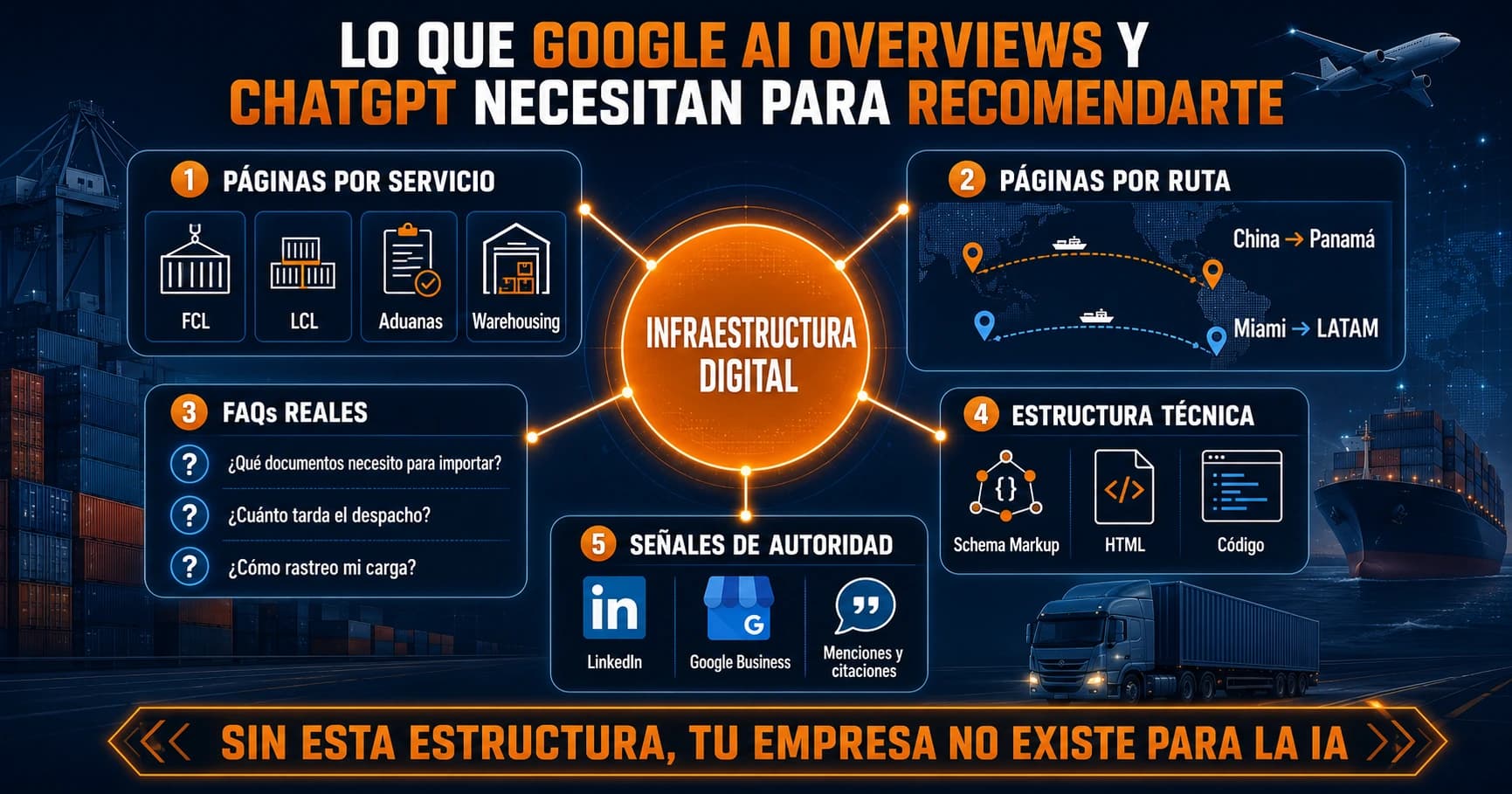
There is no magic formula. But there are very clear patterns in the logistics companies that start gaining visibility.
Specific pages per service
Not one generic page. Each service needs its own structure: FCL, LCL, air freight, warehousing, customs, refrigerated, last mile.
Pages per route or market
Examples: "FCL China → Panama", "Miami consolidation → LATAM", "refrigerated cargo Central America". Specificity matters enormously for SEO and GEO.
Real FAQs
AI tools favor pages that function as answers. What documents do I need? What transit times do you handle? Do you handle IMO cargo? Do you work EXW or FOB?
Correct technical structure
Semantic HTML, schema markup, speed, indexability, mobile optimization, clear architecture. It's not just design — it's digital infrastructure.
Authority signals
Google AI Overviews and ChatGPT look for corroboration: active LinkedIn, Google Business Profile, mentions, technical articles, specialized content, brand consistency.
The content that works in SEO/GEO is no longer generic
Google AI Mode, AI Overviews, and ChatGPT don't just look for pages that mention a keyword. They look for content that helps answer a specific question better.
For a logistics company, that means content must be based on real operational experience: routes it handles, types of cargo it dominates, problems it solves, real client questions, practical cases, and its own data.
A generic page about "international logistics services" contributes little. A page that explains how an FCL China → Panama works, what documents are needed, which ports are involved, and what transit times are reasonable, contributes much more.
It's not about publishing more content. It's about publishing more specific, more useful, and harder-to-copy content.
From appearing in searches to participating in the decision
With Google AI Overviews, AI Mode, and ChatGPT, part of the evaluation happens before the click. The buyer asks. AI synthesizes options. And often forms a first impression without visiting multiple sites.
For a logistics company, this completely changes the priority. Having a website available is no longer enough. Your company needs to be structured so that Google and AI tools can understand what services you offer, what routes you handle, what type of cargo you dominate, and why you are a reliable option.
In logistics, SEO/GEO is no longer just about traffic. It's about participating in the moment where the buyer starts forming preference.
What freight forwarders and 3PLs can do today
You don't need to rebuild everything immediately. But you do need to start correcting direction.
Audit whether your services are explained specifically or generically — would someone who doesn't know you understand exactly what you do?
Check if you have separate pages per service and specialization — FCL, LCL, customs, warehousing, air freight.
Evaluate whether your content answers real client questions — not just describes services, but answers concrete doubts.
Search for your own services in Google AI Mode, AI Overviews, and ChatGPT without using your brand — do you appear?
Verify whether your company actually appears when someone searches for exactly what you do in LATAM.
For years, many logistics companies were able to grow without strong digital infrastructure because the market depended almost entirely on relationships and referrals.
That is starting to change.
Companies that better structure their services, routes, and specialization digitally will have an enormous advantage over the next few years. Not necessarily because they are the largest — but because they will be the easiest to find, understand, and evaluate.
The question is no longer whether this matters. The question is who is going to adapt first.

Juan Carlos Morales
Founder, Eurekarank
Freight forwarder with over 20 years of experience in international logistics in LATAM. Founder of Eurekarank, specialists in digital infrastructure for B2B logistics and industrial companies.
Frequently asked questions
What does SEO mean for freight forwarders?
SEO for freight forwarders means structuring a logistics company's website to appear when clients search for specific services like FCL, LCL, warehousing, customs, or specific routes like 'freight forwarder Panama' or 'FCL China LATAM'.
What does GEO mean in logistics?
GEO (Generative Engine Optimization) — also known as AEO (Answer Engine Optimization) — means optimizing the content and structure of a logistics company so that tools like Google AI Overviews, Google AI Mode, and ChatGPT can understand and recommend it correctly.
Are SEO and GEO the same thing?
Not exactly. SEO remains the technical and structural foundation — indexation, architecture, clear content. GEO expands how that information is interpreted and used by generative AI tools. Google has confirmed that AI Overviews and AI Mode still depend on the traditional search index.
Why don't most logistics companies appear in Google AI Overviews or ChatGPT?
Because their sites are too generic, don't clearly explain routes or specialization, don't have separate pages per service, and lack technically interpretable structure for AI — schema markup, semantic HTML, real FAQs.
What type of content helps freight forwarders and 3PLs most?
Specific pages per service, pages per trade route, real FAQs that answer concrete client questions, useful technical content based on real operational experience, and clear structures that answer specific searches.
Does this only apply to freight forwarders?
No. It also applies to 3PL operators, last-mile companies, warehousing, customs agents, transport companies, and B2B logistics operators in general.
Want to know how ready your company is?
Free visibility audit on Google and AI tools
We review how your company appears on Google AI Overviews, ChatGPT and organic searches — and tell you exactly what to improve.
Request Free Audit