TL;DR
SEO for warehousing companies is not about ranking for one generic term like “3PL.” Buyers search for specific services such as warehouse fulfillment Miami, bonded warehouse near me, cold storage warehouse, cross-docking services, or 3PL warehouse for ecommerce. If your website does not clearly explain your services, locations, facility type, and operational strengths, Google and AI tools have little reason to recommend you. The goal is not just to appear. The goal is to be considered when buyers are choosing a storage, fulfillment, or distribution partner.
Warehousing is a critical node in the logistics chain. Without it, cargo doesn't move, ecommerce doesn't fulfill, and supply chains break down.
And yet, most warehouses — dry storage operators, fulfillment centers, cold storage providers, bonded warehouses, and 3PLs with storage — are nearly invisible online.
Not because they lack infrastructure. Because their websites don't explain what they do in the language buyers use to search for it.
How do buyers search when they need warehousing services?
Buyers search for the warehouse service they need, not always for the term your company uses internally.
A warehouse operator may call itself a 3PL, logistics provider, fulfillment partner, or distribution center. That language is valid. But the buyer often searches in a simpler way:
"warehouse fulfillment Laredo"
"bonded warehouse near me"
"cold storage warehouse"
"refrigerated warehouse Miami"
"3PL warehouse for ecommerce"
"cross-docking services"
"fulfillment center USA"
That is the real search behavior behind warehousing demand. It is fragmented by service, location, cargo type, temperature requirement, inventory flow, and urgency. A buyer looking for refrigerated space has a different need than a buyer looking for ecommerce fulfillment. An importer looking for bonded storage is not the same as a retailer looking for cross-docking.
SEO for warehousing companies should target a cluster of specific searches, not only one generic keyword.
What is SEO for warehousing companies?
SEO for warehousing companies is the process of making your storage, fulfillment, and distribution services clear enough for Google and buyers to understand.
It is not about adding keywords randomly. It is about translating your real operation into searchable information. A strong warehouse website should answer:
→What type of warehouse do you operate?
→Where are your facilities located?
→Do you offer storage, fulfillment, cross-docking, kitting, labeling, or distribution?
→Do you handle ecommerce, retail, industrial cargo, food, pharma, or spare parts?
→Do you offer cold storage, refrigerated warehousing, or bonded warehousing?
→Do you use a WMS or inventory visibility system?
Most warehouse websites do not fail because the company lacks operational value. They fail because the website does not explain that value in the language buyers use. A buyer may not know your company name. They may only know they need “warehouse fulfillment in Atlanta” or “refrigerated warehouse Miami.” If your website does not connect your operation to that search, you are invisible at the moment of demand.
What are GEO and AEO for warehousing companies?
GEO and AEO help AI systems understand when your company should be mentioned, cited, or used as an answer.
SEO focuses on search engines like Google and Bing. GEO, or Generative Engine Optimization, focuses on visibility inside AI-driven answers from tools such as ChatGPT, Google AI Overviews, AI Mode, and Perplexity. AEO, or Answer Engine Optimization, focuses on structuring content so it answers specific questions clearly.
For a warehouse, this means your website should not only say “We offer integrated logistics solutions.” It should say something closer to: “We provide dry storage, ecommerce fulfillment, cross-docking, and inventory management for B2B importers and ecommerce brands in South Florida.” The second version connects service, audience, and location — which is exactly what AI systems need to understand and recommend your company.
We covered how this dynamic plays out across the broader logistics sector in our guide to SEO and GEO for freight forwarders and logistics companies.
Why do warehouses stay invisible in Google and AI search?
Warehouses stay invisible because their websites often describe the company instead of answering buyer intent.
A warehouse may have real infrastructure, trained staff, dock doors, forklifts, WMS processes, security, and years of reliability. But online, it only says “complete logistics solutions.” That phrase does not help a buyer compare options, and it does not help Google understand whether the company is relevant for “bonded warehouse near me,” “cold storage warehouse,” or “3PL warehouse for ecommerce.”
Generic service pages
Many warehouse websites have one page called "Services," where storage, fulfillment, distribution, cross-docking, and value-added services are mentioned in one short section. That is not enough. If you offer warehouse fulfillment, explain it. If you offer cross-docking, explain when and how you use it.
No location specificity
Warehousing is a location-driven business. Buyers care about proximity to ports, airports, highways, customers, carriers, and final delivery zones. A warehouse in the Miami submarkets (Doral, Medley, Hialeah), along the Texas border (Laredo, El Paso, San Antonio), or in California's Inland Empire (Ontario, Fontana) should not hide its geography. Location is part of the service.
Supplier language, not buyer language
The provider says "3PL." The buyer searches "warehouse," "storage," "fulfillment," or "distribution center." Your website should use both. A strong sentence: "We are a 3PL warehouse providing storage, fulfillment, and distribution services for ecommerce and B2B companies."
No proof of operational capability
Many warehouse websites list services but show little evidence. A serious buyer wants to understand process, systems, cargo types, facility type, and service areas. You do not need to disclose confidential information, but you do need enough detail to prove the operation is real and qualified.
What does a warehouse need to appear for high-intent searches?
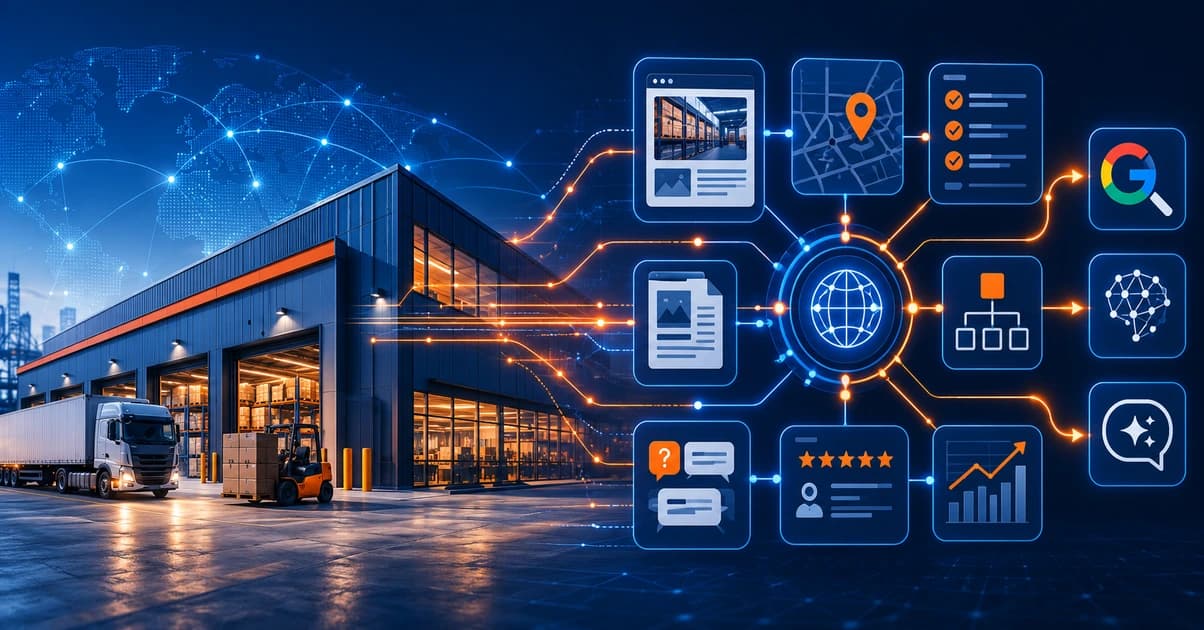
A warehouse needs specific service pages, location clarity, operational proof, structured FAQs, and consistent company information. Visibility comes from connecting what the buyer searches with what the company actually does.
Service pages for each core capability
A company that offers storage, fulfillment, cross-docking, kitting, labeling, returns, and distribution should not hide everything on one page. Each service answers a different search intent. An ecommerce fulfillment page can target "3PL warehouse for ecommerce" or "fulfillment center USA." A cold storage page can target "cold storage warehouse" or "refrigerated warehouse Miami." A bonded warehousing page can target "bonded warehouse near me" or "customs bonded warehouse."
Useful location pages
Location pages should explain why the area matters — access to airport cargo, port activity, regional delivery zones, or trade lanes when relevant. A page should not only say "warehouse in Miami." It should explain what that location unlocks operationally.
Clear cargo and industry language
A warehouse may handle consumer goods, industrial parts, ecommerce products, pharma-related products, food-grade cargo, automotive parts, or electronics. Those differences matter because buyers search based on their cargo problem.
Strong FAQ sections
FAQs help buyers, Google, and AI systems understand your service boundaries. Useful questions: Do you offer short-term storage? Do you offer cross-docking? Can you handle ecommerce fulfillment? Do you offer refrigerated warehousing? Do you operate a bonded warehouse? Can your WMS integrate with ecommerce platforms?
Visible contact paths
Warehousing buyers often need fast answers — availability, location, rates, requirements, and whether you can handle their cargo. Make it easy to call, email, request a quote, or send inventory details.
Why do long-tail warehousing searches matter?
Long-tail warehousing searches matter because they reveal the buyer's specific operational need.
A generic search like “3PL” can mean many things — a definition, a comparison, software, or outsourcing research. A specific search is different. “Warehouse fulfillment Miami” suggests a buyer needs fulfillment in a defined market. “Bonded warehouse near me” suggests a customs-related storage need. “Cold storage warehouse” suggests temperature sensitivity. “3PL warehouse for ecommerce” suggests order fulfillment, inventory control, pick and pack, and shipping.
These searches are closer to the buying decision. The buyer already knows the problem; now they need a credible provider. For warehouse companies, the opportunity is not only search volume — it is intent.
A lower-volume search can be more valuable than a generic one if it attracts a buyer with a real operational need.
How does AI change visibility for warehousing companies?
AI changes visibility by turning search from a list of links into a recommendation and comparison process.
In traditional search, a buyer types a query and reviews results. In AI-assisted search, the buyer may ask: “What are good warehouse fulfillment options near Miami for ecommerce brands?” or “What should I look for in a cold storage warehouse?” or “Compare 3PL warehouses for ecommerce fulfillment in the USA.”
This changes the competition. Your company is not only competing for a ranking position — it is competing to be included in the answer, cited as a relevant source, or considered as a possible vendor. AI systems work better when information is clear, specific, consistent, and easy to extract.
Your website should read like a serious operational profile, not like a brochure.
How do you move from being found to being chosen?
You move from being found to being chosen by giving the buyer enough confidence to contact you.
Ranking is not the final goal. Visibility without trust does not create qualified leads. A buyer comparing warehousing providers wants to reduce risk. They are asking: Can this company handle my cargo? Is the facility in the right location? Do they understand my industry? Can they support my volume? Do they have inventory control? Will they answer quickly? Can they scale if my operation grows?
This is where operational experience matters. A marketer may write “we optimize your supply chain.” A logistics operator knows the buyer is worried about stock accuracy, cut-off times, dock scheduling, damaged cargo, temperature control, documentation, and communication. That difference should show in the content.
For warehousing companies, SEO and GEO are not about traffic. They are about being the company a serious buyer decides to contact.
What should warehousing companies do today?
Warehousing companies should start by fixing the pages that buyers and AI systems use to understand the business.
Rewrite the homepage around buyer intent. It should immediately explain what type of warehouse you operate, where you operate, and who you serve. "Warehouse fulfillment, storage, and distribution services for ecommerce and B2B companies in South Florida" is stronger than "Your strategic partner in integrated logistics solutions."
Create one page per core service. Build separate pages for storage, fulfillment, cross-docking, cold storage, bonded warehousing, ecommerce fulfillment, and distribution — only if those are real services. Accuracy matters.
Build service + location content. If location matters to your buyer, make it visible: warehouse fulfillment in Miami, cross-docking services in Laredo, cold storage warehouse in the Inland Empire. Avoid duplicating the same page with only the city changed.
Add operational FAQs. Answer real buyer questions about storage types, inventory systems, cargo requirements, fulfillment process, cross-docking, bonded storage, and location coverage.
Strengthen your Google Business Profile. For local warehouse searches, keep accurate categories, services, address, phone, hours, photos, and descriptions. This is especially important for "near me" searches.
Make your company entity clear. State the company name, services, markets, and contact details clearly. This helps search engines and AI systems understand that your company is a real entity.
Track conversions, not only traffic. The goal is qualified inquiries. Track quote requests, phone clicks, email clicks, WhatsApp clicks, and form submissions.
Final thought: warehousing visibility is now part of the sales process
Warehousing visibility is now part of the sales process because buyers use Google and AI tools before they contact providers.
A warehouse can have strong operations and still lose opportunities because it is not discoverable. The buyer may never know your facility exists. AI tools may never mention your company. Google may show competitors with weaker operations but clearer content. This is not a web design problem — it is a visibility problem.
For warehousing companies, 3PLs, fulfillment centers, cold storage providers, bonded warehouses, and distribution centers, the next stage of digital competition will be based on clarity. Who explains their services better? Who is easier to understand, verify, and recommend? That is what SEO and GEO for warehousing companies should solve.
See real captures of this kind of visibility on our Evidence page.

Juan Carlos Morales
Founder, Eurekarank
Juan Carlos Morales is the Founder of Eurekarank. He is a freight forwarder with more than 20 years of experience in international logistics in LATAM. Through Eurekarank, he helps logistics and industrial B2B companies build digital infrastructure for SEO, GEO, AEO, and AI-driven search visibility.
Frequently asked questions
What types of warehouse companies need SEO?
Any warehouse company that wants to be found by buyers needs SEO. This includes dry warehouses, cold storage warehouses, bonded warehouses, fulfillment centers, distribution centers, and 3PL operators with storage services. The more specific the service, the more important SEO becomes.
Is SEO different for cold storage or refrigerated warehouses?
Yes. SEO for cold storage and refrigerated warehouses should be more specific. Buyers need to understand temperature-controlled services, cargo types, location, and handling capabilities. A page that only says "we offer storage" is not enough.
How should a bonded warehouse appear in search?
A bonded warehouse should appear for searches related to customs-controlled storage, imported goods, and location-based queries like "bonded warehouse near me" or "customs bonded warehouse." The website should explain what bonded warehousing means, who it is for, and how to request information.
Should cross-docking have its own service page?
Yes, if it is a real service you offer. Buyers searching for cross-docking usually care about speed, dock handling, scheduling, and reduced storage time. The page should explain when the service makes sense and what cargo you handle.
Does a WMS help with SEO or GEO?
A WMS does not automatically improve SEO, but it can strengthen your content if it is part of your real operation. Buyers care about inventory visibility, order accuracy, reporting, and integrations. If your warehouse uses a WMS, explain how it supports fulfillment, storage, and ecommerce operations.
How important is location for warehouse SEO?
Location is critical because storage and fulfillment decisions are tied to geography. Buyers care about proximity to ports, airports, highways, customers, carriers, and delivery zones. A warehouse should make its location clear and explain why it matters.
Want to know how visible your warehouse is?
Free visibility audit on Google and AI tools
We review how your company appears on Google AI Overviews, ChatGPT and organic searches — and tell you exactly what to improve.
Request Free Audit